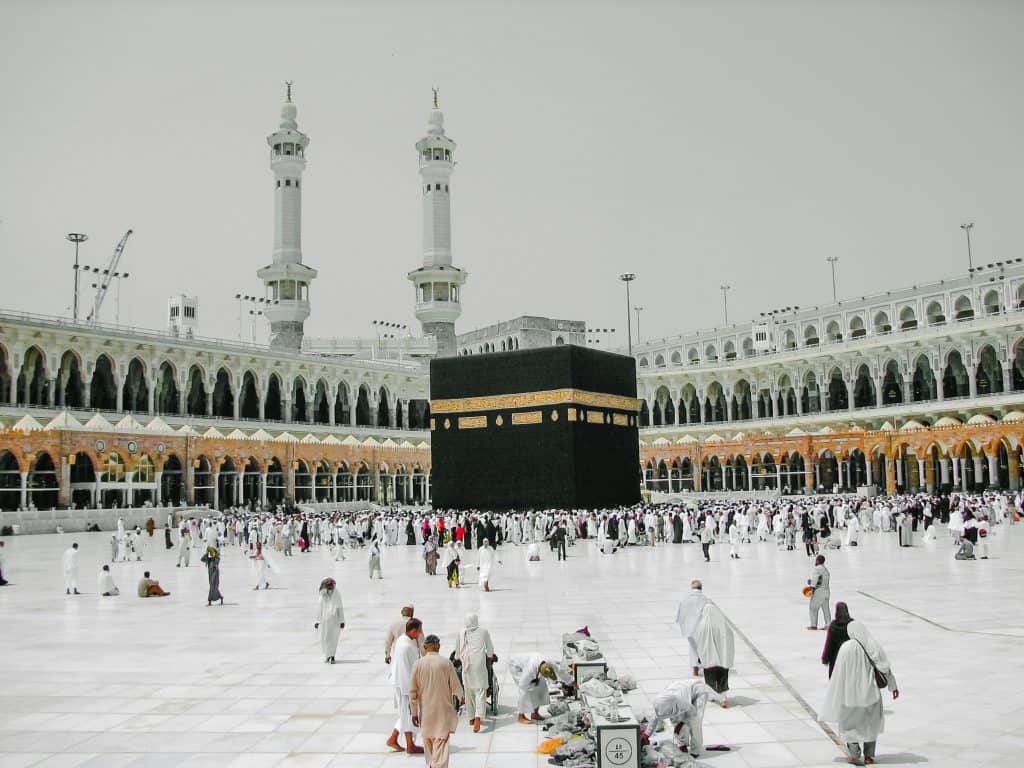
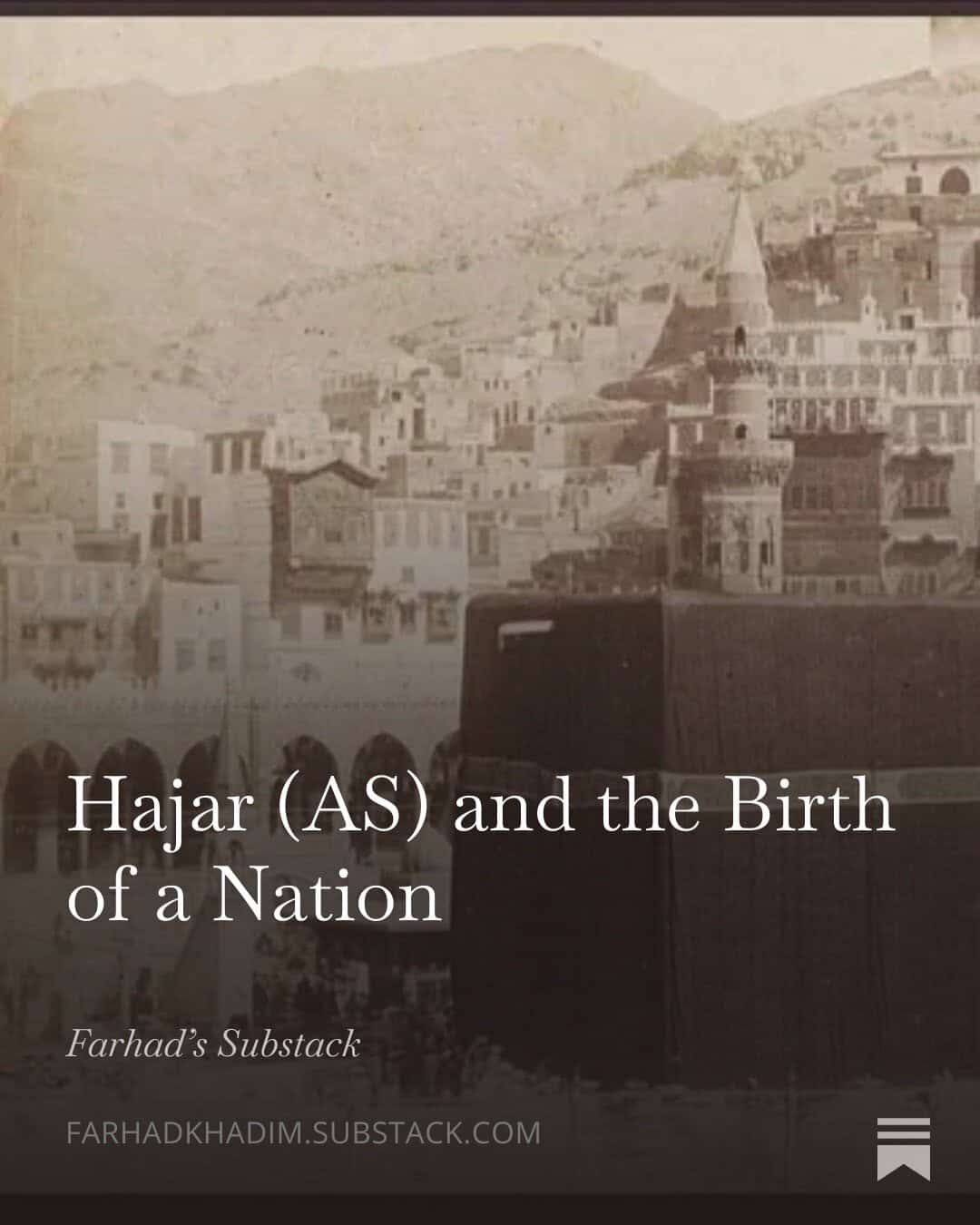
I was reflecting on some writings about Hajar (AS) and the role she was chosen to play in the genesis of revelation, and specifically on the rites of Hajj and Umrah.
What became increasingly clear was that the story of Hajar (AS) is not merely a story of survival; it is the story of how Allah chose a mother’s faith, courage and perseverance to lay the foundations of a nation and a sacred tradition that would endure until the end of time. Hajar was no peripheral figure in the unfolding of revelation. Rather, her struggle, her determination and her unwavering trust in God became part of the spiritual architecture of a way of life synonymous with submission to Allah.
When Prophet Ibrahim (AS) was ordered to take her and her son Ismael to the valley of Makkah, she willingly accompanied him, perhaps unaware at that time what his command from God was.
When they arrived and Ibrahim settled them and then turned to leave, that willing acceptance changed to questioning – a questioning that is often glossed over because of the closure of the subject after his final answer.
Before moving too quickly to speak about her acceptance, let’s pause for a moment to reflect upon her questioning. For within that questioning lies a profound lesson for believers across the centuries.
An Exercise of Understanding
Hajar’s inquiry was not an act of defiance, but an exercise of understanding.
Faith did not require her silence; rather, it permitted her to seek clarity before embracing a burden that would alter the course of history.
Hajar did not simply allow a decision to be made without understanding the rationale. The act itself, that of leaving a wife and a child alone in an unpopulated area, would have been frowned upon even in pre-modern times.
Husbands have always been considered to be protectors of women, responsible for their safety and survival.
Hajar was already familiar with the unwavering faith of Ibrahim.
He was the example par excellence of submission to God. He reliance on God almighty and God’s favour on him was already established through his miracle of being saved from the fire and in confronting the King.
In his turning away to leave, Hajar instinctively knew that it would have to be something unusual for a man of Ibrahim’s stature to make this decision.
Yet, she did not assume; she did not remain quiet only to second guess herself later, or worse yet to ascribe bad intentions on his part.
She instead articulated her concern – not once, but three times, insisting that he answer.
Even more profound is that she knew him to be a man of God; it would be a command of God to make him adopt this course of action.
A Command from God
Her follow-up question when he remained silent, and his subsequent answer must have been something that she had already considered: a man of God, a Friend of God who was elevated to a high rank in the life already lived, would not choose to abandon his responsibility unless he was commanded to do so.
Ibrahim’s confirmation that it was the command of God was immediately accepted with no further question; in fact it was swiftly turned into a moment of historic trust in God that it has become one of the most profound manifestations of Tawakkul ever witnessed – consistent with the examples of those righteous souls before and after her: the mother of Musa, Maryam the mother of Isa and Asiyah, the wife of Pharaoh.
Hajar had seen the submission of Ibrahim before; she had lived with him long enough to know his acceptance of the divine command.
And she had seen the grace of God on him to know that the merciful lord will not abandon her.
Abraham’s Prayer
What she did not see was his turning to God in a deep plea to take care of his family and to incline the hearts of men toward them, setting up Makkah as a place of habitation and a seat of spiritual reawakening in later years.
The Qur’an preserves this remarkable prayer:
“Our Lord, I have settled some of my descendants in an uncultivated valley near Your Sacred House, our Lord, that they may establish prayer. So make hearts among the people incline toward them and provide for them from the fruits that they might be grateful” (Qur’an 14:37).
Unknown to Hajar, the future of Makkah was already being written through the supplication of Ibrahim (AS). The barren valley before her eyes would one day become the spiritual centre of the Muslim world, drawing believers from every corner of the earth.
Hajar’s response was a result of pure, divine grace: contentment with no fear, acceptance with no remorse and full trust in God’s protection.
Hajar’s Unrelenting Search for Water
Yet, when Ibrahim leaves she did not waste time – she made effort – for her and her child’s survival. This was a mother’s instinct – protection of the life that she was entrusted with.
And what an effort she made! The mountains could not contain her as she ran repeatedly between them to find water.
What thoughts must have crossed her mind at a time of great vulnerability and exposure to the elements?
What we know for sure is that her faith in God and her trust that He would not abandon her fuelled her determination.
This is perhaps one of the greatest lessons in tawakkul.
Hajar did not mistake trust in Allah for passivity. She did not sit and wait for provision to descend from the heavens. Instead, she ran. She searched. She exerted every effort available to her. The miracle of Zamzam emerged while she was in motion. Her story teaches that reliance upon Allah does not negate human effort; rather, sincere effort is itself an expression of reliance upon Him.
And just as Allah would later reward Ibrahim (AS) for his willingness to sacrifice what he loved most, He rewarded Hajar with the miraculous gift of Zamzam.
Zam Zam – More Than Water
Yet Zamzam was more than water for a desperate mother and child. It transformed an uninhabited valley into a place of settlement, sustenance and eventually civilization. What began as a mother’s search for survival became the genesis of a city that would later become the birthplace of the final Messenger, Muhammad ﷺ.
Hajar carried the weight of history on her shoulders. She walked in the footsteps of the prophets before her, and alongside the greatest of messengers and the Friend of God.
She was not granted a vision of the generations that would emerge from her son, nor of the prophets and believers who would follow in their footsteps. She was simply asked to trust, to strive and to endure. Yet through those seemingly ordinary acts, Allah fashioned one of the most extraordinary legacies in human history.
Safa and Marwa – Symbols of Worship
It is perhaps for this reason that Allah elevated the very locations of her struggle into symbols of worship:
“Indeed, Safa and Marwah are among the symbols of Allah…” (Qur’an 2:158).
The hills between which she ran in desperation became sanctified through divine remembrance, transforming a mother’s struggle into an act of worship for generations yet unborn.
It is therefore no wonder that the Sa’i has been embedded as an integral rite of Hajj and Umrah. Every pilgrim who traverses Safa and Marwah retraces the footsteps of a mother whose faith transformed a barren valley into the spiritual heart of the Muslim world.
The ritual is not merely a remembrance of history. It is a declaration that Allah immortalized the struggle of Hajar (AS), preserving it as an act of worship until the end of time, in the same manner that He preserved the steadfastness and submission of Prophets Ibrahim and Ismaeel in the rites of Hajj.
Through her perseverance, trust and effort, a desolate valley became a sanctuary, a family became a nation, and a mother’s footsteps became part of the sacred rhythm of faith itself.
Ibrahim, Ismaeel and Hajar are models of faith and purity for the entire world. Their story encapsulates a family of believers seeking and receiving the Grace of Allah. It demonstrates that pure faith can be achieved with reliance on God and that the sacrifice of the things we love for God’s sake is crucial for the attainment of the real love – the love of the Creator.
In particular, Hajar’s commitment and steadfastness to Ibrahim, a Man of God, is a model for Muslim men and women who seek the Face of God through clarity, worship, reliance and sacrifice.